Man inverted in the Pangolin while Dr. Mike holds a spine model
Decompression · Core strength · Spinal flexibility

From back pain to bulletproof core.

The Pangolin is spinal decompression, core strength and spinal flexibility in one strap. Start gentle, then progress all the way to full strength training, without gravity compressing your spine on every rep.

Three tools in one

Decompress, strengthen and mobilize your spine without switching equipment.

  • Decompress

    Hang into the strap for gentle spinal traction that takes pressure off your discs. Replaces the inversion table. Made for people working through chronic low back pain, disc bulges and herniations.

  • Strengthen

    Train your abs, obliques and spinal erectors with your spine unloaded. The same strap takes you from gentle rehab work to hard strength training.

  • Mobilize

    Move your spine through full flexion, extension and side bending, and groove hip hinges and squats while your spine stays decompressed.

    See the Pangolin in action

    Hang in to unload your spine, then train through your full range without leaving the strap.

    Start where you are. Progress at your pace.

    You don't start fully suspended. Every movement on the Pangolin scales from gentle to advanced by changing how much of your body is off the ground.

    Level 1

    Gentle

    Traction: Your head and shoulders stay on the ground while the strap gently decompresses your lower back.

    Extension & flexion: Stand with your feet on the ground and move through a small, comfortable range.

    Level 2

    Building

    Traction: Raise the strap so more of your body comes off the ground and the stretch deepens.

    Extension & flexion: Walk your feet up the wall a little at a time and work through a bigger range.

    Level 3

    Advanced

    Traction: Fully suspended.

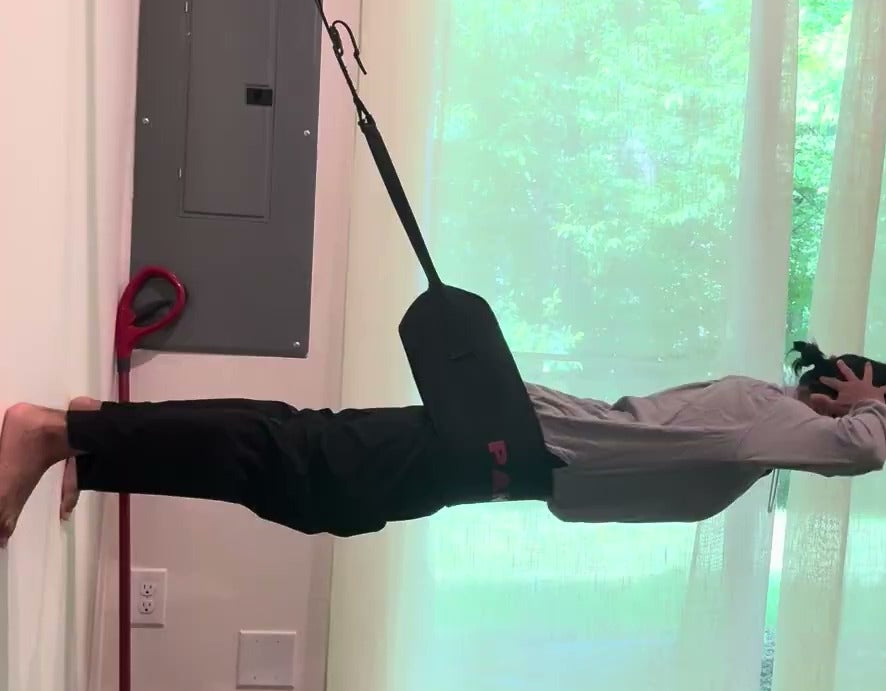
    Extension, flexion & rotation: Feet up the wall until your body is parallel to the floor, or your feet are above your shoulders. Add rotation and side bending.

    Move up a level only when the one you're on feels controlled and comfortable.

    Is the Pangolin right for you?

    It's a suspension trainer, so you need to be able to move around and get yourself in and out of the strap.

    A great fit if you:

    • Live with chronic back pain but can still move around and exercise
    • Have some exercise or training background, even if it's been a while
    • Have a low to moderate level of fitness or better
    • Want a stronger core and a healthier spine, pain or no pain

    Not the right fit if you:

    • Are in severe pain (8 out of 10 or higher) that makes basic movement hard
    • Can't get down to the floor and back up on your own
    • Have limited strength, mobility or balance, as many older adults do

    Setup and safety

    One wall anchor and you're ready to train. Read the manual before your first session.

    Recommended

    Wall anchor

    1. Choose a flat wall with solid structure behind it (a stud or masonry) and room to lie down and move.
    2. Mount a heavy-duty eye hook about 7 feet up. The manual's range is 6 to 9 feet, or at least 1 foot above your head.
    3. Clip the Pangolin's carabiner to the hook.
    4. Weight-test before every workout, and every time you adjust the strap: pull on the strap, then slowly lean into the support pad.

    Fixed anchors should be installed by a licensed contractor.

    The wall anchor we use →
    Backup option

    Door anchor

    Only use a door that is solid wood or heavy metal with strong hinges. Hollow-core and lightweight doors aren't strong enough.

    • Hang the Pangolin on the side of the door that pulls it closed while you train.
    • Lay a 2x4 board on the floor, at least 8 inches wider than the door opening, to brace your feet.
    The door anchor we recommend →

    Max user weight: 200 lbs. Adults only. Inspect the strap and hardware before each use.

    Read the Pangolin manual (PDF)
    Prone hover on the Pangolin

    Built for the movements your spine needs most

    The Pangolin does a few things better than anything else. Master these and you've covered what matters for a strong, healthy back.

    1. 1

      Spinal traction

      Hang into the strap to take the pressure off your spine and discs.

    2. 2

      Back extension

      Strengthen your spinal erectors through a full range, with your spine unloaded.

    3. 3

      Back flexion

      Train your abs and curl your spine forward without compressing it.

    Plus side bends for your obliques and QL.

    When you're ready, there are hundreds more exercises you can do on it, from supine chest presses and prone rows to V-ups, hip hinges and squats. But the four above are the core of the Pangolin.

    Get your Pangolin →

    Why the Pangolin

    Everything your spine needs, nothing it doesn't.

    • Replaces your inversion table

      Real spinal traction without a bulky frame taking over a corner of your room.

    • Full range of motion

      Extension, flexion and side bending, so you train your spine the way it's built to move.

    • Whole-core strength

      Abs, obliques and spinal erectors, trained together with bodyweight.

    • Scales with you

      The cam buckle adjusts strap length in seconds. Start gentle, progress to advanced.

    • Made in the USA

      Built in Alabama by Elk River, a maker of fire safety and rescue harnesses. Pull-tested to 2,200 lbs.

    • Simple wall anchor

      Mount one eye hook anchor 7 feet up on a flat wall and you're set. A solid door works as a backup.

      Erector spinae anatomy drawn on a man training in the Pangolin, with Dr. Mike

      From pain relief to performance

      Dealing with chronic back pain? Start with decompression to take the pressure off, then rebuild strength so the relief lasts.

      Already training? Use it to build a stronger core and a more resilient spine, and to groove hinges and squats without loading your back.

      Either way, it's the MoveU approach: fix it from the core out.

      Rectus abdominis anatomy drawn on a man training in the Pangolin, with Dr. Mike
      Why I use it every day

      A message from Dr. Mike

      The Pangolin didn't start as a back pain tool. A Pilates instructor designed it for full-spine core strength and put one in my hands in 2018.

      What I found surprised me. For people with chronic back pain, it did something almost nothing else can: it let them decompress their spine and train it at the same time, without gravity and their own bodyweight pressing down on every rep.

      So I spent the next few years refining it. I finalized the design in 2022, and every Pangolin is now made in Alabama by Elk River, a manufacturer of fire safety and rescue harnesses. Each one is pull-tested to 2,200 lbs.

      Today it's mandatory for every one of my VIP clients, and they all tell me it's the most valuable tool they own. My wife and I have used ours every single day for years. It's where I do almost all of my core work.

      Once you start using it, you'll use it for the rest of your life.

      Dr. Mike Wasilisin, DC
      Founder, MoveU

      Questions

      Can it help with a disc bulge or herniation?

      The Pangolin was designed for people working through disc bulges, disc herniations and chronic low back pain who can still move around and exercise. Start at Level 1, with gentle traction and a small range of motion, and progress from there.

      Does it replace an inversion table?

      For most people, yes. You get spinal traction and decompression without a bulky frame, and you can train in it too, which an inversion table can't do.

      What exercises can I do with it?

      The core of the Pangolin is spinal traction, back extension and back flexion, plus side bends. Those are the movements it does better than anything else. Once you've got those down, there are hundreds more you can do, like supine chest presses, prone rows, V-ups, hip hinges and squats.

      Who is the Pangolin not for?

      It's not for anyone in severe pain that makes basic movement hard, anyone who can't get down to the floor and back up on their own, or people with limited strength, mobility or balance, including many older adults. You need to be able to get in and out of the strap yourself.

      How do I set it up?

      We recommend installing a heavy-duty eye hook about 7 feet up on a flat wall. That's the most secure setup and the one we use. Here's the wall anchor we use.

      You can also hang it over a door, but only if the door is solid wood or heavy metal with strong hinges. Here's the door anchor we recommend.

      Full setup steps are in the Pangolin manual (PDF).

      Is it safe?

      Talk to your healthcare provider before starting any new exercise program. The Pangolin is for adult use only. Make sure your anchor is secure, inspect the strap and hardware before each use, and follow the included Pangolin manual.

      From back pain to bulletproof core.